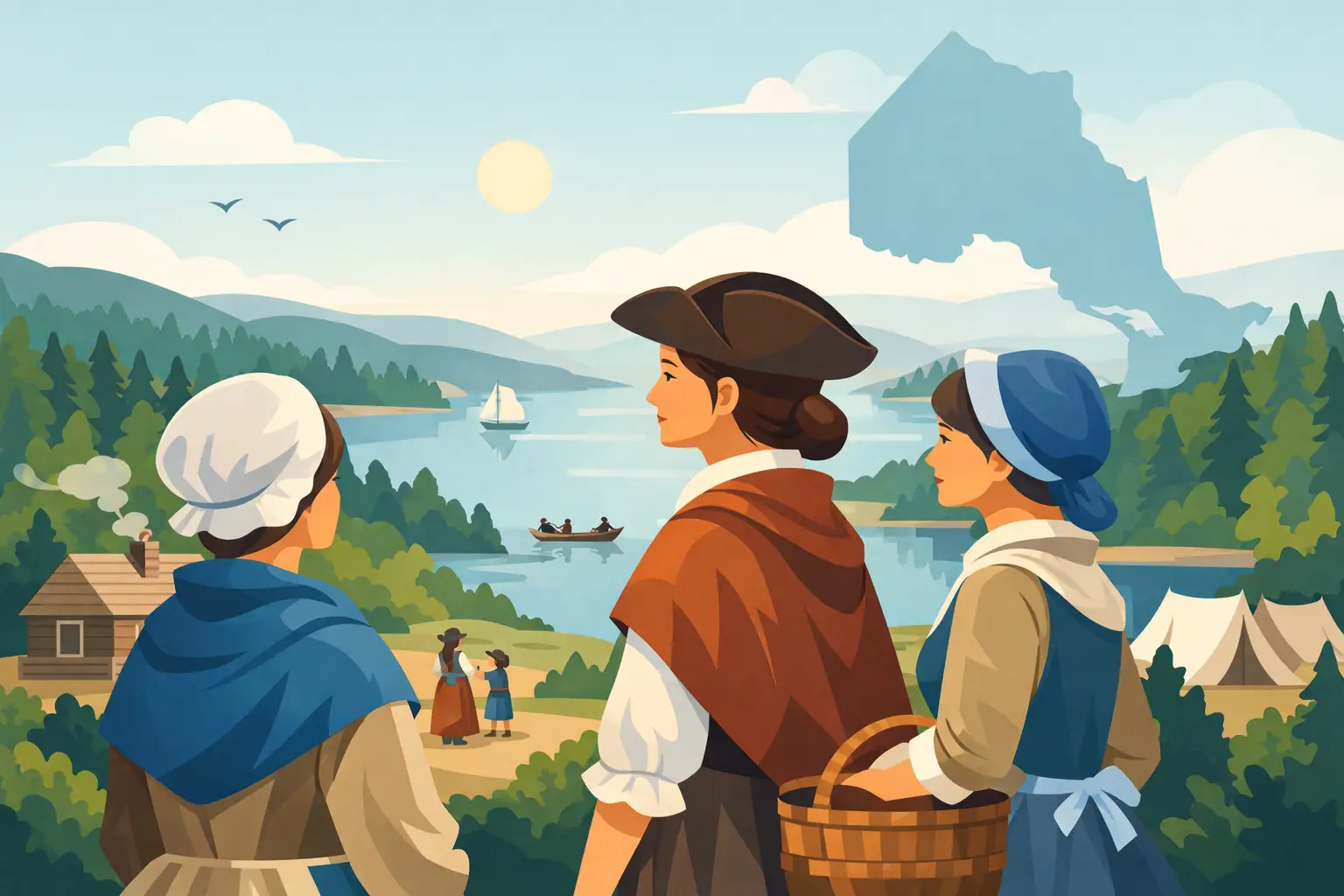
A clearing beside a creek, a rough cabin not yet sealed against the wind, children needing food, clothing, comfort, and order – this is where the history of united empire loyalist women truly begins. Not in proclamations or military lists, but in the daily labour of women who crossed into British North America after the American Revolution and helped turn uncertain ground into enduring home.
Their names do not always appear where they should. Many were recorded only as wives, widows, or daughters of men whose service to the Crown earned the family a place in the Loyalist story. Yet anyone who looks honestly at the settlement of eastern Ontario, along the St. Lawrence and inland creeks such as Hoople Creek, can see that these women were not peripheral figures. They were central. They carried memory, faith, skill, discipline, and a fierce capacity to endure loss without surrendering the future.
Why united empire loyalist women matter
To speak of Loyalist settlement without its women is to tell only half a history. Men may have petitioned for land, served in regiments, or signed documents, but women bore a different and equally foundational burden. They kept families intact through displacement. They managed scarcity in places where stores, roads, mills, and neighbours were often far away. They nursed the sick, buried the dead, prepared food, spun cloth, mended tools through ingenuity, and raised children in households built under relentless pressure.
This is not sentimental correction. It is historical truth. Early Canadian settlement depended on domestic economies, and those economies depended on women. A homestead did not survive because land was granted on paper. It survived because someone transformed raw provisions into meals, fibres into clothing, herbs into medicine, fear into steadiness, and wilderness into ordered life.
For many families, the first generation born or raised in Upper Canada inherited more than acreage. They inherited habits of perseverance shaped in large measure by mothers and grandmothers whose names were spoken in kitchens, at gravesides, and in family recollection long before historians began to look for them.
The burdens they carried after the Revolution
The term Loyalist can sound settled and official, but the lived reality was often uprooted and painful. Many united empire loyalist women had already endured war before ever reaching what is now Ontario. Some saw homes seized or abandoned. Some followed husbands whose military service left the family exposed to danger and uncertainty. Others were widowed by conflict or by disease and hardship in its aftermath.
When these women arrived in British North America, safety did not immediately become comfort. The new life demanded relentless practical effort. Land was often uncleared. Shelter was crude. Winters were severe. Food could be short. Pregnancy and childbirth took place far from the support systems these women may once have known. Children needed care while fathers were away for labour, militia obligations, or the slow work of establishing a farm.
There is a tendency to romanticize pioneer endurance, but the truth is sterner than romance. Some women adapted to frontier life with remarkable strength. Others suffered deeply under it. Those two truths can stand together. Honour requires honesty. Their courage was not the absence of fear or grief. It was the decision, repeated day after day, to continue despite them.
Women as builders of home, kin, and community
A settlement becomes a community only when human bonds take root. This, too, was women’s work.
United Empire Loyalist women preserved family identity at a moment when displacement could easily have erased it. They remembered births, deaths, marriages, old neighbours, former homes, and the moral codes by which a family understood itself. In a new land, memory was a form of inheritance. It told children who they were and why their sacrifices mattered.
Women also shaped the social and spiritual life of early settlements. Through shared labour, visiting, worship, mutual aid, and the ordinary exchange of care, they helped create the web of support that made survival less lonely. A woman might assist at a birth in one cabin, sit through a wake in another, and then return home to her own unending chores. These acts were not marginal. They were the quiet architecture of community life.
In regions such as eastern Ontario, where distances could isolate households, such bonds meant the difference between despair and endurance. A settlement’s strength was measured not only by cleared acres but by the willingness of women to sustain one another through illness, widowhood, crop failure, and bereavement.
United Empire Loyalist women in eastern Ontario
Eastern Ontario holds some of the most resonant Loyalist ground in Canada because the landscape still carries the memory of first settlement. Along waterways and concession roads, the story of the province’s beginnings is not abstract. It is personal, local, and often familial.
Here, united empire loyalist women helped establish households that became lineages. Their labour fed growing communities. Their faith steadied families through the harsh first years. Their decisions affected where children married, how farms expanded, what churches took shape, and which family stories endured. For descendants, this is why the search for a female ancestor can feel so powerful. One is not only finding a name. One is recovering the moral centre of a family history.
This is especially true in places like Hoople Creek, where settlement history remains deeply tied to regional identity. The women who lived there were not symbols. They were individuals with temperaments, sorrows, strengths, loyalties, and private battles. To restore them to view is to give the past its human face again.
That is part of what gives a work such as The Matriarchs of the Hoople Creek Loyalists its weight. By grounding story in research and speaking through the intimate possibilities of narrative, it allows readers to encounter these women not as footnotes, but as living presences whose choices still echo across the region.
Why the records so often fail them
One reason these women remain overlooked is simple and frustrating: the archive was not built with them in mind. Official records tended to privilege landholding, military service, legal petitioning, and other public acts more often associated with men. Women appear, but often indirectly. They are named in marriage records, widows’ claims, church registers, cemetery inscriptions, or family papers, then disappear again into the background.
For genealogists and local historians, this creates both challenge and calling. Reconstructing a woman’s life may require patience and imagination grounded in evidence. It means reading around the silence. A baptismal entry, a land petition by a widow, a mention in a will, a cluster of family names on a burial ground – each may offer only a fragment. Yet fragments, carefully honoured, can reveal a life of immense consequence.
It also means accepting that not every detail can be recovered. There is humility in this work. Some stories remain partial. But partial is not meaningless. Even where the record is thin, the pattern is unmistakable: women carried the daily burdens that allowed Loyalist communities to endure.
More than supporting figures
There is a habit in older history writing to praise women by calling them supportive. The word is not wrong, but it is insufficient. It suggests assistance to the main story rather than participation in it.
United Empire Loyalist women were not merely standing beside history. They were making it. They transmitted culture, stabilized households, managed crises, and shaped the character of early Canadian life in ways both intimate and lasting. Their authority was often exercised within the family and community rather than the legislature or parade ground, but that does not make it lesser. In a pioneer society, the power to preserve life, order, and belonging was foundational power.
This recognition matters now because remembrance shapes identity. When Canadians understand that women were builders of settlement, not ornaments to it, the national story becomes truer and more whole. Descendants, too, gain something precious: the chance to see their foremothers not as shadows, but as agents of endurance and inheritance.
What their legacy asks of us
To remember these women well is to do more than admire their hardship. It is to speak their names where we can, to preserve the local histories that still hold them, and to resist any version of the past that leaves them out because their work was domestic, repetitive, or undocumented by power.
Their legacy lives in Ontario place names, in family lines, in old churchyards, in regional memory, and in the stubborn continuity of communities first shaped by sacrifice. But it lives most fully when we approach them with gratitude and seriousness. They helped lay the human foundations of this country, often without recognition, often at great personal cost.
If we listen carefully, the story of united empire loyalist women is not distant at all. It is still present in the land, in the family record, and in the quiet conviction that those who carried the heaviest burdens deserve to be remembered with honour.
Leave a Reply